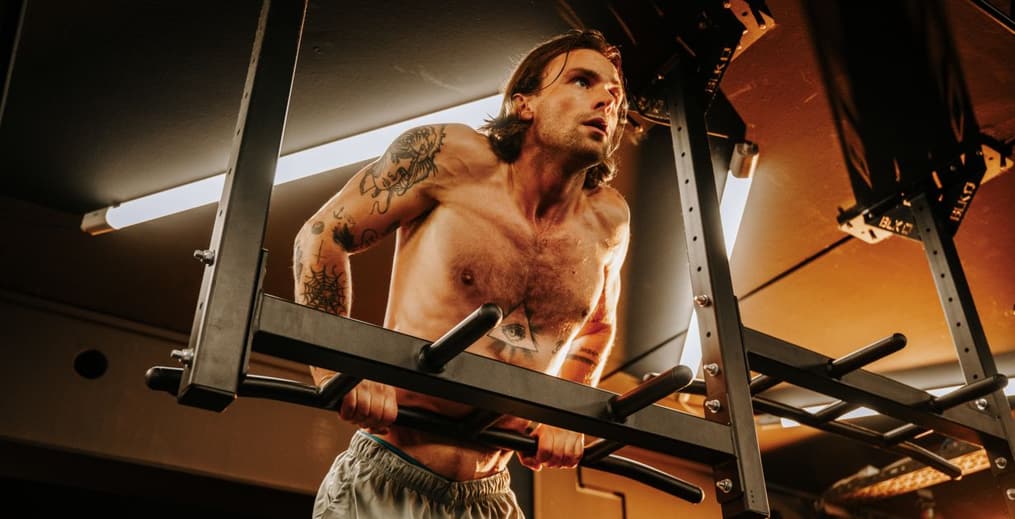
Training your triceps is important for building stronger, more defined arms, because it's the largest muscle in your upper arm,¹ making up roughly two-thirds of its mass. While many people focus on their biceps when trying to improve their arm size and strength, the triceps are the real powerhouse behind much of your arm development.
These muscles play a major role in everyday movement, so they are well worth training. Whether you're working toward your first Pushup, chasing a new personal best in the gym, or simply want stronger arms, training them should be a regular part of your fitness routine.
What are the triceps?
The triceps is the large muscle along the back of your upper arm, and its main job is to straighten your elbow (elbow extension). Properly called the triceps brachii, it stretches from your shoulder and upper arm down to the point of your elbow, where it attaches to the ulna, one of the two bones in your forearm.
That makes the triceps a "push" muscle because it works during pressing exercises, not pulling ones. Every time you push yourself off the floor, press a weight overhead, throw a ball, or perform a Pushup, your triceps are hard at work.
Unlike the biceps, which bend the elbow, the triceps extend it. Together, these muscles work as a team to produce smooth, controlled movement and stabilize the joints throughout your arm.
Because the triceps account for around 60–70% of your upper arm's muscle mass, strengthening them doesn't just improve performance – it also has the biggest impact on building stronger, more defined arms.
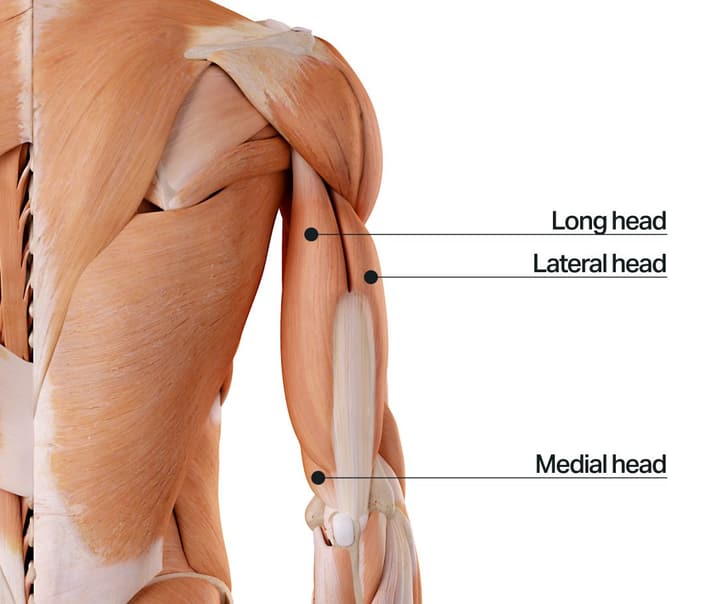
What are the three heads of the triceps?
The triceps has three heads: the long head, lateral head, and medial head. And while all three straighten your elbow, each plays a slightly different role depending on the movement.
Long head
The long head is the largest of the three and runs along the inside of the back of your upper arm. Unlike the other two heads, it originates from the shoulder blade rather than the upper arm bone, meaning it crosses both the shoulder and elbow joints.
Because of this unique position, the long head helps with two important movements:
- Straightening the elbow
- Extending the shoulder by pulling your arm backward
Exercises where your arms are raised overhead place the long head under a greater stretch, making it work especially hard. Including these movements in your routine helps ensure balanced development rather than focusing only on the outer portion of the muscle.
Lateral head
The lateral head sits on the outside of your upper arm and is often the most visible portion of the muscle. It's responsible for creating the "horseshoe" shape many people associate with well-developed arms.
This head becomes particularly active during heavy pressing movements such as Pushups, Dips, Bench Presses, and Overhead Presses. As the resistance increases, the lateral head contributes more force to extend the elbow.
If your goal is building strength or increasing arm definition, exercises that challenge the lateral head should be a regular part of your training.
Medial head
The medial head lies underneath the other two heads and isn't as easy to see, but it's no less important.
This portion of the muscle stays active during nearly every elbow extension movement, regardless of the weight you're using. It also plays an important role in stabilizing the elbow joint and assisting the larger heads throughout pressing exercises.
Since all three heads work together, the most effective routine includes a variety of movement patterns instead of relying on just one exercise.
Why do strong triceps matter?
Your triceps are involved in nearly every pushing movement you perform, from bodyweight exercises to lifting groceries, carrying luggage, or pushing yourself up from the floor.
They also improve performance in sports that involve throwing, swimming, climbing, or overhead movements, including tennis, volleyball, basketball, and swimming. Building stronger triceps can also improve other upper-body exercises.
In addition to generating force, they help stabilize both the shoulder and elbow joints. That stability also helps your arms move more smoothly and can take some strain off your shoulders and elbows during repetitive movements.
How do you train your triceps effectively?
To train your triceps effectively, build your routine around compound pushing movements two to three times a week using a full range of motion. You don't need dozens of isolation exercises to build stronger triceps.
Research consistently shows that compound movements, or exercises involving multiple joints and muscle groups, are highly effective for developing both strength and muscle because they allow you to produce more force while training them alongside the chest, shoulders, and core.
Instead of chasing endless exercise variety, focus on these key principles:
- Perform each repetition with control.
- Use a full range of motion whenever possible.
- Follow progressive overload, gradually increasing the challenge over time by adding repetitions, slowing the tempo, or progressing to more difficult variations.
- Allow adequate recovery between sessions so your muscles can rebuild and grow.
Consistency matters far more than finding the "perfect" exercise.
The best bodyweight tricep exercises
One of the biggest advantages of bodyweight training is that some of the best tricep exercises require no equipment at all, and you can do them at home or almost anywhere, while still providing enough resistance to build strength and muscle.
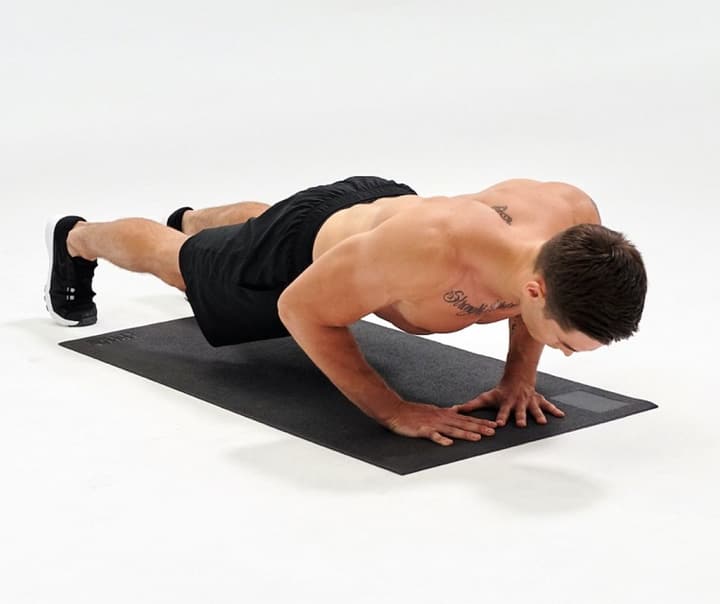
Diamond Pushups
Diamond Pushups are a go-to bodyweight move for targeting the triceps.
By positioning your hands directly beneath your chest so your thumbs and index fingers form a diamond shape, you shift more of the workload toward the triceps compared to a standard Pushup.² At the same time, your chest, shoulders, and core continue to work together to stabilize the movement.
Start in a high plank with your hands close together beneath your chest, lower yourself under control while keeping your elbows tucked close to your sides, and push back up.
Diamond Pushups recruit all three heads of the triceps, which is what makes them so effective for building pushing strength.
Straight Bar Dips
Straight Bar Dips are a form of tricep dips with your palms facing down. They're an excellent compound exercise that builds strength in the triceps, chest, shoulders, and core.
Using a sturdy horizontal bar or similar surface that can safely support your body weight, begin by supporting yourself with straight arms and a grip slightly wider than shoulder-width.
Keeping your core engaged, slowly lower your body until your lower chest approaches the bar. Press yourself back up by fully extending your elbows while maintaining control throughout the movement.
Because you're moving your entire body weight, Straight Bar Dips place significant demand on all three heads of the triceps, making them one of the most challenging bodyweight pressing exercises.
Parallel Bar Dips
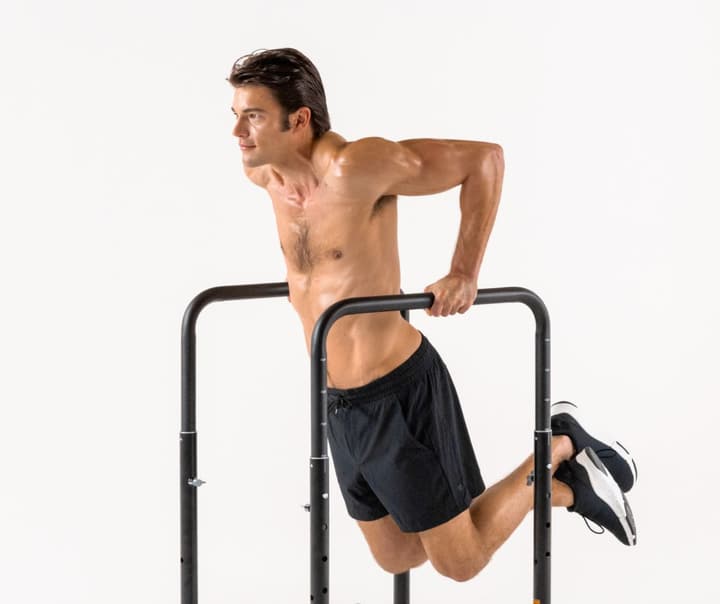
Dips on parallel bars are a popular bodyweight exercise that strengthens the triceps. By keeping your torso upright, it places more load on your triceps, turning it into a true tricep dip.
Start by gripping a set of parallel bars and pressing yourself up until your arms are straight and supporting your body weight. Keeping your torso tall and upright and your elbows tucked close to your sides, slowly bend your elbows to lower yourself until they reach about 90 degrees. Then press back up to your starting position.
Avoid leaning too far forward so the work stays on your triceps and doesn't shift to your chest. Lowering only to around 90 degrees also protects your shoulders by not placing added weight on them.
Because you're lifting your full body weight, Parallel Bar Dips challenge all three heads of the triceps at once, and you can scale them by adding weight with a dip belt or slowing the lowering phase.
The best tricep exercises with weights
Bodyweight training can take you surprisingly far, but adding external resistance is an effective way to continue building strength and muscle once you've mastered the basics.
And you don't need a fully equipped gym to get results. Even a single dumbbell or resistance band can open up a variety of exercises that target the triceps from different angles.
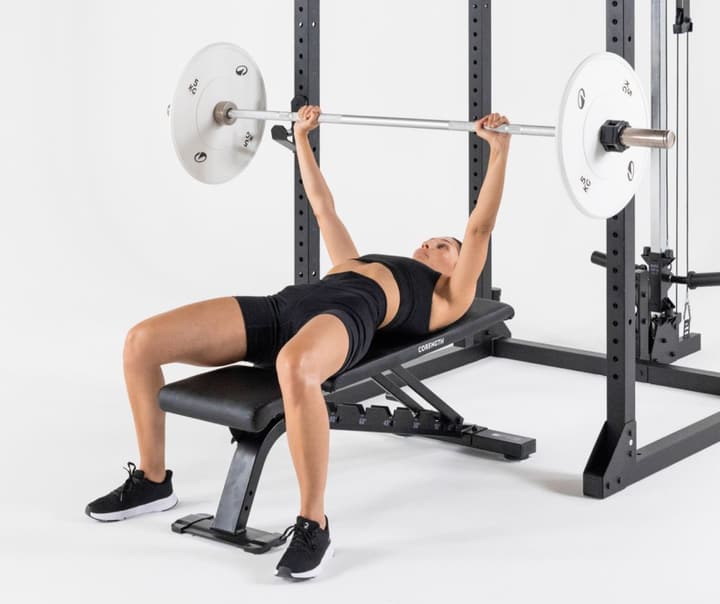
Bench Press
The Bench Press is one of the most popular upper-body strength exercises, and while it's often thought of as a chest movement, your triceps play a major role in every repetition.
As you press the weight away from your chest, they're responsible for extending your elbows and finishing the movement.³ Stronger triceps often translate to a stronger Bench Press, especially during the final portion of each repetition.
The Bench Press also lets you load the triceps with far more weight than most isolation movements, which makes it one of the best lifts for building long-term pushing strength. Focus on controlled repetitions instead of simply lifting the heaviest weight possible.
Push Press
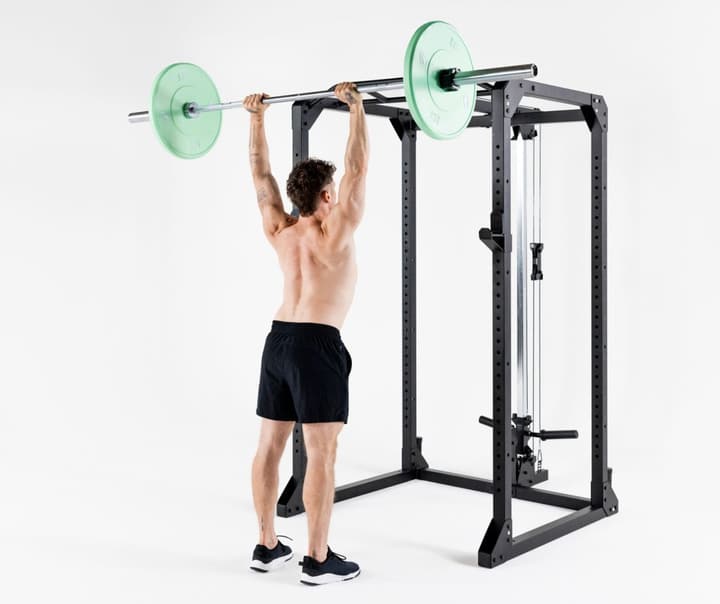
The Push Press is a compound movement that combines lower-body power with upper-body strength.
Unlike a Strict Overhead Press, the Push Press uses a small bend in the knees to help drive the weight upward. Once the bar is moving, your shoulders and triceps take over to complete the lift.
Because the Push Press allows you to move heavier loads than a Strict Press, it places significant demands on the triceps during the lockout portion of the lift while also developing coordination and explosive power.
Overhead Triceps Extension
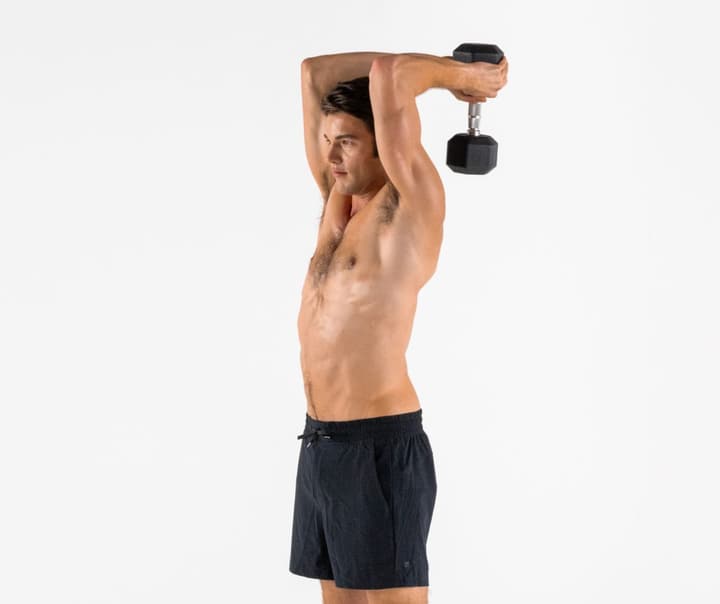
If there's one exercise that deserves a place in nearly every triceps workout, it's the Overhead Triceps Extension, one of the best tricep exercises with dumbbells.
Raising your arms overhead stretches the long head more than most other exercises, making it especially good for the largest part of the muscle.⁴
Avoid letting your elbows flare outward, as this reduces tension on the muscle and can place unnecessary stress on the shoulders.
Close-Grip Bench Press
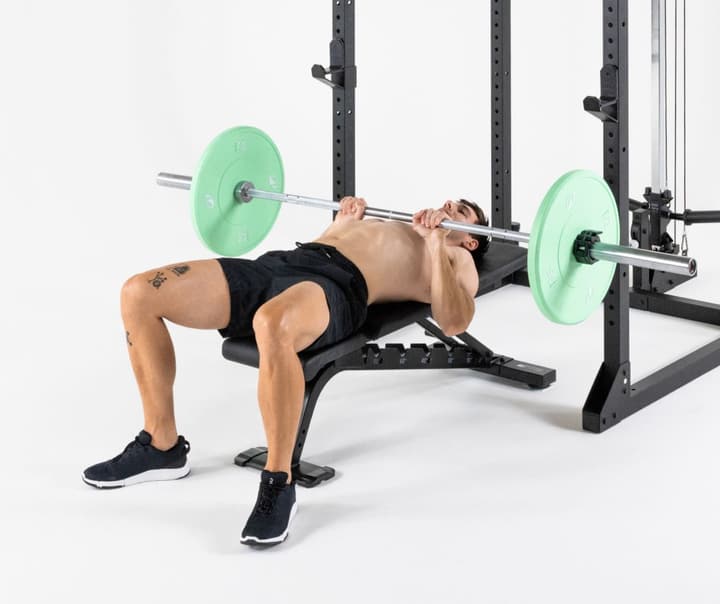
A simple adjustment to your Bench Press can place even greater emphasis on the triceps.
Using a narrower grip than your standard Bench Press shifts more of the workload onto the triceps while still allowing you to lift relatively heavy weights.
Because it's a compound movement, the Close-Grip Bench Press develops strength that's highly transferable to Pushups, dips, and other pressing exercises.
Do you need isolation exercises?
Not necessarily.
Compound exercises like Pushups, Dips, Bench Presses, and Overhead Presses recruit the triceps extremely well while also strengthening your chest, shoulders, and core.
However, adding one or two isolation exercises, such as Overhead Triceps Extensions, can help ensure all three heads receive enough direct work, especially if your goal is muscle growth or balanced arm development.
Rather than choosing between compound and isolation exercises, most people will benefit from including both in their routine.
Common tricep training mistakes
Even experienced athletes can fall into habits that limit their progress. Avoid these common mistakes when training them to get more out of every workout.
Only training one type of exercise
If your workouts consist entirely of Pushups or Bench Presses, you're missing opportunities to challenge them through different angles and ranges of motion.
Using momentum
Swinging weights or rushing through repetitions allows other muscles to do more of the work while reducing tension on the triceps.
Cutting repetitions short
Stopping halfway through a repetition limits how much work your muscles perform.
Forgetting recovery
Muscles don't grow while you're training – they grow while you're recovering.
How often should you train your triceps?
For most people, consistently training them two or three times per week is enough to build both strength and muscle.⁵
Since they're also involved in many chest and shoulder exercises, they often receive additional work even when they're not the primary focus of your workout.⁶
If you're following a full-body training program, your triceps may already be getting enough stimulus through movements like Pushups, Dips, and Overhead Presses.
If you're following an upper- and lower-body split or a push-pull-legs routine, adding one or two direct triceps exercises during your upper-body or push workouts is usually sufficient.
The goal isn't to train them every day – it's to train them consistently while allowing enough time to recover and adapt.
Let's recap
Strong triceps power nearly every pushing movement you perform, support your shoulders and elbows, and help you move more efficiently both during workouts and in everyday life.
And no matter which exercises you choose, progress doesn't happen overnight. Your muscles only continue adapting if they're challenged over time, so make sure to incorporate progressive overload into your training plan.
You can progressively overload them by:
- Performing more repetitions.
- Adding weight.
- Slowing the lowering portion of each repetition.
- Increasing your range of motion.
You don't need to make huge jumps every workout. Prioritizing good technique and making small, consistent improvements over time will lead to the biggest long-term gains.
Try Freeletics nowSources
- Holzbaur, K. R. S., Murray, W. M., Gold, G. E., & Delp, S. L. (2007). Upper limb muscle volumes in adult subjects. Journal of Biomechanics, 40(4), 742–749.
- Cogley, R. M., Archambault, T. A., Fibeger, J. F., Koverman, M. M., Youdas, J. W., & Hollman, J. H. (2005). Comparison of muscle activation using various hand positions during the push-up exercise. Journal of Strength and Conditioning Research, 19(3), 628–633.
- American College of Sports Medicine. (2021). ACSM's guidelines for exercise testing and prescription (11th ed.). Wolters Kluwer.
- Maeo, S., Wu, Y., Huang, M., Sakurai, H., Kusagawa, Y., Sugiyama, T., Kanehisa, H., & Isaka, T. (2023). Triceps brachii hypertrophy is substantially greater after elbow extension training performed in the overhead versus neutral arm position. European Journal of Sport Science, 23(7), 1240–1250.
- Schoenfeld, B. J., Ogborn, D., & Krieger, J. W. (2016). Effects of resistance training frequency on measures of muscle hypertrophy: A systematic review and meta-analysis. Sports Medicine, 46(11), 1689–1697.
- Schoenfeld, B. J. (2010). The mechanisms of muscle hypertrophy and their application to resistance training. Journal of Strength and Conditioning Research, 24(10), 2857–2872.
