RPE scale, or the Rate of Perceived Exertion scale, is used to help you evaluate how hard you are working during a workout. It’s important because it provides the framework for you to tune into your body and ensures that you are working out at your level and your pace.
RPE is just one of several tools the Freeletics Coach uses to help you manage different workout intensities and improve safely and confidently.
In this article, we’ll get into why feedback is necessary, explore the RPE scale, and explain how this relates back to your Freeletics Coach feedback.
What is RPE?
The Rate of Perceived Exertion scale, or RPE, is a subjective measure that lets you evaluate your intensity levels, or how hard you think you are pushing yourself during a physical activity.
RPE is a key tool in performance diagnostics within competitive sports and is also used in clinical settings to monitor markers like blood pressure and heart rate response. And while there are different ways to measure RPE, two commonly used scales are the Borg Scale and the Category-Ratio Scale (CR-10).1
The Borg RPE Scale (6-20)
The Borg Scale starts at a rating of 6, meaning no effort at all, and goes up to 20, being your all-out max effort – think sprinting where it’s difficult to breathe. This scale was originally designed to correlate with a person’s beats per minute (heart rate).
The CR-10 RPE Scale (1-10)
The Category-Ratio Scale, CR-10, was later introduced with perceived efforts ranging from 1 (minimal effort) to 10 (maximum effort).
Both scales offer a reliable way to measure intensity – or how you’re feeling during your workout. Using a scale allows you to assign a value to a feeling and better communicate with your coach or personal trainer.
And this rating technique can be applied to a variety of workouts, from cardio sessions like running, cycling, and rowing to strength training, weightlifting, and bodyweight HIIT workouts.
Below, we’ll get into how RPE is applied across different training modalities.
How is RPE measured?
Applying RPE to general weight training
When applying the RPE scale to resistance training, it’s typically used in combination with Reps in Reserve, or RIR.
Reps in Reserve literally means just that – how many more reps could you do before you reach training to failure on your lift. So instead of asking yourself, “how hard did I push?”, you ask, “how many reps could I still do?”
Let’s take the CR-10 Scale as an example: an RPE of 10 means there’s no way you could do even one more rep with good form. In strength training, an RPE of 10 is usually associated with your one-rep max (1RM), which is the heaviest you can lift for one single rep with good form.
Because your 1RM represents your all-out max, it can help guide your other weight selections during your lift. For example, if you complete a lift and rate it at an RPE of about 8, that means you have about 2 RIR, or you could do 2 more reps before failure.
*Coach note: Freeletics workouts are designed to be performed alone, so we generally aim for the 7-8 RPE range where a spotter is not necessary. This intensity range is also effective for developing both strength and muscle growth.

Applying RPE to cardio workouts
In cardio-based workouts like running, rowing, and cycling, RPE correlates strongly with your heart rate, breathing, and oxygen uptake (VO2 Max).
And what’s great about the RPE scale for these types of workouts is that it helps you to measure exercise intensity without technology – or put simply, it can help you estimate your heart rate training zones.
Knowing what heart rate training zone you are working out in is incredibly important to ensure that you’re working in the intended intensity.
It also helps you to become more in tune with your body and understand different efforts and paces. If you do have a heart rate monitor, you can use it to track this more precisely.
3 simple ways to help find your RPE
- The “Talk test”: is the gold standard you’ll often find used to measure RPE. And it literally refers to how well or how easily you can speak while you’re working out, which reflects your current intensity level.2
- Speed check: if you had to slow down, stop, or couldn’t complete the assigned interval, it could mean you are engaging in intensive training at your maximum effort, or an RPE of 9-10. If this wasn’t the intention of the workout, it’s a great way to signal you should pull back.
- Tank check: after a lift, ask yourself, “How many more reps could I have done?” Identifying your RIR, or how much you have left in the tank, is the most direct way to determine your RPE for weightlifting.
Why is feedback important?
Accounts for how you feel
Feedback, whether that’s an internal self-check with RPE or an external chat with a personal trainer or coach, is important because it ensures you’re working out at the “right-for-you-that-day” intensity.
We aren’t machines, and things like poor sleep, stress, and also your nutrition can impact how much you have to give during a workout.
For example, a moderate intensity run, or RPE of 4-6, might look different on a day you slept 8 hours vs. a day you were up all night with a sick child. And that matters, so you can adjust your training to match how you feel versus what you should be doing according to a training plan.
Ensures training at the right intensity
This also applies to not pushing yourself enough during a training session. If your workout was too easy, those necessary physical adaptations won’t take place to build muscle or improve endurance.
Muscle growth happens when your training creates enough mechanical tension and metabolic stress to trigger a growth response. While micro-tears play a role, the real magic happens when you challenge your muscles with enough load and volume.
On the flip side, if you’re new to exercise or just starting out, it’s important that you don’t push too hard too soon. Progression should be slow and strategic to help prevent over-training or worse, injury.
Using RPE can help you stay in the right intensity range and teach you how to listen to your body to adjust your training as needed.

How is RPE used in Freeletics?
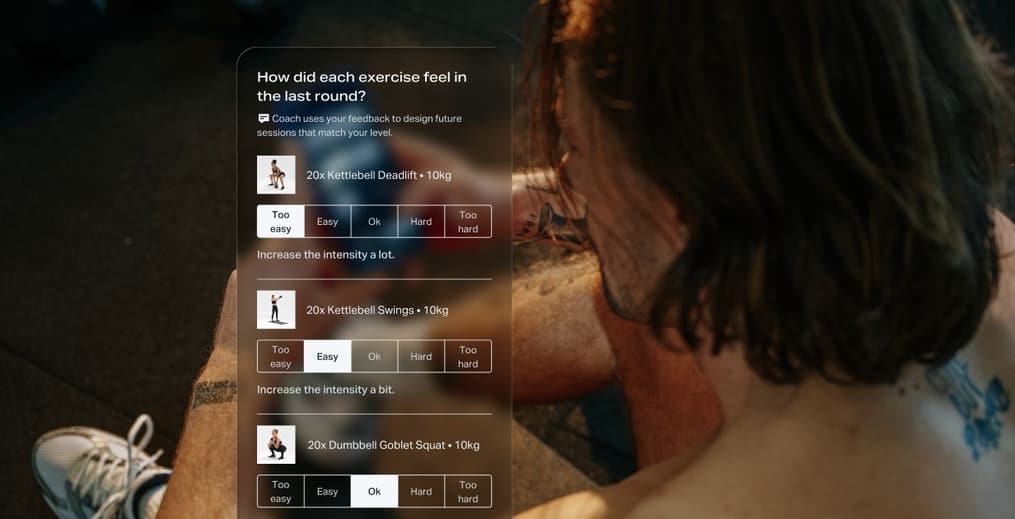
After each Freeletics Coach workout, you’ll see a screen asking for your feedback. Think of this as your RPE rating for your workout.
Was the exercise too hard? Too easy? Did you need to make a change? All of this should be reflected in your feedback.
The Coach then uses this information to create your next workout, helping to decide whether to scale things back or push you a little harder.
The feedback scale includes five options to rate your session, ranging from “Too Easy” (no effort at all) to “Too hard” (you couldn’t complete the exercise or interval with good form). And this rating is applied to each individual exercise, so you can clearly communicate which movements worked for you and which didn’t.
In this way, your workout plan is constantly refined based on how you feel, helping you progress safely towards your goal at your pace.
Let’s recap
The value of RPE cannot be overstated. Whether you use the Borg Scale, the CR-10, or the Freeletics adjusted scale, no single method is better.
What matters most is consistently checking in with yourself and your body and using that feedback to progress in a smart and safe way. And that doesn’t mean you shouldn’t push hard.
Some workouts, like high-intensity workouts, are meant to be hard – to challenge you and change you. But it should be the intent of the workout, not the outcome of you pushing yourself beyond your limits.
The goal is finding that sweet spot where progress happens and results are found.
RPE doesn’t require anything extra – simply tune into your body, listen to it, and stay consistent. Over time, it will become one of your most valuable training tools.
Try Freeletics nowYou might also be interested in:


Sources
[1] Carrie Ritchie, Rating of Perceived Exertion (RPE), Journal of Physiotherapy, Volume 58, Issue 1, 2012, Page 62, ISSN 1836-9553
[2] Kwon Y, Kang KW, Chang JS. The talk test as a useful tool to monitor aerobic exercise intensity in healthy population. J Exerc Rehabil. 2023 Jun 28;19(3):163-169.
