Indoor cycling, or riding a bicycle in a stationary setting, offers a low-impact workout that strengthens and improves cardiovascular endurance. While the terminology varies, the core principle is the same: Pedaling against resistance to create a controlled cardiovascular and muscular training stimulus.
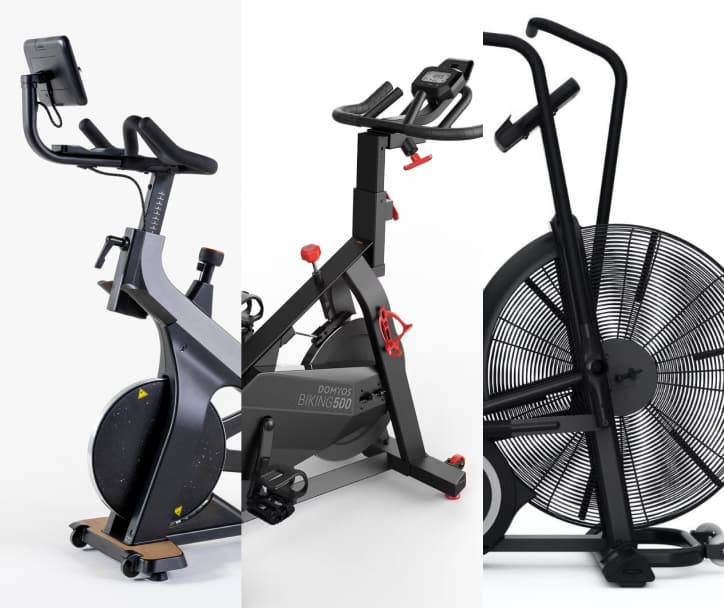
And indoor cycling isn’t limited to just one kind of bike. It can include traditional stationary bikes, studio “spin” bikes, air bikes that use a fan for resistance, or smart bikes and trainers that connect to apps and automatically adjust resistance.
For Free Athletes who value versatility, resilience, and performance, indoor cycling offers joint-friendly conditioning, builds aerobic capacity, and delivers measurable progress through clear performance metrics. Let’s dive in!
Types of indoor bikes
Stationary bikes and spin bikes
These are common in gyms and fitness studios. Resistance is usually adjusted manually via a knob or lever. They are reliable, simple, and effective for interval and endurance training.
Air bikes
Air bikes use a fan to create resistance. The harder you pedal (and push/pull the handles), the greater the resistance. They are popular in high-intensity training due to their full-body demand.
Smart bikes and trainers
Smart bikes and trainers connect to software platforms and measure performance metrics like power output in watts. Resistance can change automatically based on programmed workouts, virtual courses, or target training zones.
Understanding the key metrics: power, cadence, resistance, and zones
One of the greatest advantages of indoor cycling is the ability to precisely quantify effort.
Watts and functional threshold power (FTP)
Power output, measured in watts, reflects how much work you are producing. Unlike heart rate, which can fluctuate due to sleep, hydration, or stress, power provides an objective measure of performance.
Functional threshold power (FTP) is the highest average power you can sustain for approximately one hour. It is widely used to set personalized training zones and guide progression.1
Cadence
Cadence refers to how fast you pedal, measured in revolutions per minute (RPM). Lower cadences with higher resistance emphasize muscular strength and torque, while higher cadences with moderate resistance challenge neuromuscular coordination and cardiovascular capacity.
Resistance
Resistance determines how difficult it is to turn the pedals. Increasing resistance increases muscular demand, especially in the quadriceps and glutes, while maintaining cadence under load trains force production and fatigue resistance.
Training zones
Training zones are typically based on percentages of FTP or heart rate. Lower zones (e.g., Zone 2) target aerobic development, while higher zones improve lactate threshold and anaerobic power. Structured training across zones has been shown to efficiently improve endurance performance.2
Movements and muscles involved in indoor cycling
What movements are involved?
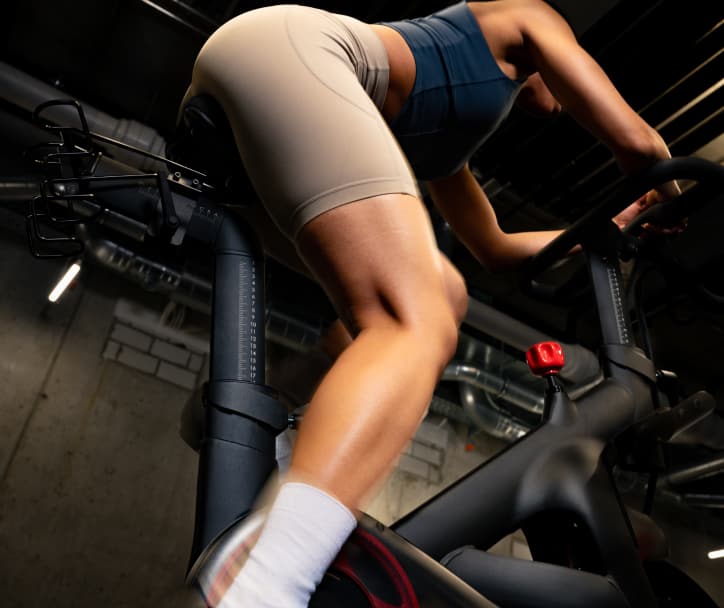
Cycling primarily involves repetitive flexion and extension at the hip, knee, and ankle.
Each pedal stroke can be divided into two main phases:
- Downstroke (power phase): where hip and knee extension generate force to push the pedal downward.
- Upstroke (recovery phase): where hip flexion and hamstring engagement assist in lifting the pedal, especially when clipped into the pedals.
Although cycling is predominantly a sagittal-plane activity (forward and backward), subtle stabilization of the hips and core helps maintain alignment and efficiency.
Which muscles does indoor cycling involve?
Indoor cycling activates several major muscle groups, including:
- The quadriceps are the primary contributors during the downstroke
- The gluteus maximus drives hip extension and contributes significantly to power production
- The hamstrings assist during the upstroke and stabilize the knee
- The calves (gastrocnemius and soleus) contribute to ankle plantarflexion
- The hip flexors help lift the pedal during the recovery phase
- The core muscles - stabilize the torso and maintain posture
Electromyography studies confirm substantial activation of the quadriceps and gluteal muscles during cycling, highlighting the role in lower-body strength and endurance development.3
Benefits of indoor cycling
Low impact on joints
Compared to running and other weight-bearing activities, cycling produces significantly lower joint loading forces. This makes it particularly valuable for individuals with knee or hip discomfort and those returning from injury.
Cycling places less compressive stress on the knee joint compared to high-impact activities.4
Builds endurance and strength
Indoor cycling effectively improves aerobic capacity (VO₂max), a key marker of cardiovascular fitness.
Regular training sessions on indoor cycling bikes has been associated with improved heart and lung function, as well as enhanced muscular endurance (Garber et al., 2011).5 Higher-resistance intervals also stimulate lower-body strength adaptations, especially in the glutes and quadriceps.
Convenient and accessible
Most gyms have stationary bikes or host indoor cycling classes, and many people own home trainers or smart bikes. Weather, traffic, and time constraints often common with outdoor cycling, are eliminated, making consistency easier.
Ideal for injury recovery or cross-training
Because of its controlled, low-impact nature, indoor cycling is frequently used in rehabilitation and cross-training programs. It allows athletes to maintain cardiovascular conditioning while reducing mechanical stress on healing tissues.
Things to consider
While indoor cycling offers many benefits, it is not without limitations.
Traditional stationary bikes provide limited upper-body engagement compared to modalities like rowing or air biking. The repetitive motion, especially with improper bike setup, can contribute to knee, hip, or lower back discomfort. Additionally, some individuals find indoor cycling mentally repetitive compared to outdoor training.
Balancing cycling with strength training and mobility work helps mitigate these drawbacks.
Expert tips for getting started
Setting your seat height
A common rule of thumb: when seated with your heel on the pedal at its lowest point, your knee should be almost fully extended with a slight bend. When you return to pedaling with the ball of your foot, this results in a safe knee angle of approximately 25–35 degrees of flexion at the bottom of the stroke.
Adjusting fore-aft position
When the pedals are horizontal, your front knee should align roughly over the ball of your foot. This helps distribute force evenly and reduce knee strain.
Posture tips
Keep your chest open and shoulders relaxed. Maintain a neutral spine. Avoid excessive rounding of the lower back. Engage your core lightly to stabilize the pelvis.
Pedaling technique
Aim for smooth, circular pedal strokes rather than stomping downward. Think about driving down and scraping back with your foot at the bottom of the stroke to engage the posterior chain.
Heart rate monitor
Consider using a heart rate monitor to track your efforts over different sessions. This is an easy way to make sure you stay within your target zones for a better cycling experience.
5 Common mistakes to avoid
While hopping on an indoor bike has several benefits, there are a few mistakes you should make sure to avoid, such as:
- Adding too much resistance too soon: this can overload the knees and lead to unwanted pain or injuries
- Ignoring cadence: grinding at very low RPMs is less efficient and can cause strain or pain
- Poor bike setup: failing to properly set up the bike can compress, cause poor knee tracking, lead to poor posture, or other discomforts
- Skipping recovery: neglecting recovery between hard sessions; recovery is where the adaptations (or magic) happen
- Skimping on your strength training: relying solely on cycling without incorporating strength training can lead to muscular imbalances
How to incorporate indoor cycling into your training routine
Zone 2 endurance rides
Zone 2 training – performed at moderate intensity – builds the aerobic base. Sessions typically last in a range of 30 minutes to 90 minutes and improve mitochondrial efficiency and fat oxidation, making your body much better at burning fat for fuel during long sessions.
Interval training
High-intensity intervals, such as 4–6 rounds of 3–5 minutes at 90–105% of FTP, improve lactate threshold and aerobic power. Structured interval work is highly effective for time-efficient fitness gains.
Sprints and hill efforts
Short sprints of 10–30 seconds at maximal effort enhance neuromuscular power. Simulated hill climbs at lower cadence and higher resistance build muscular endurance and strength.
Recovery rides
Easy spins at low resistance promote blood flow, aid recovery, and maintain movement quality without adding significant fatigue. For Free Athletes balancing strength work, sport practice, and conditioning, indoor cycling can fill aerobic gaps without excessive joint stress.
Let’s recap
Indoor cycling is more than just pedaling in place. It is a scalable, measurable, and scientifically supported training method that improves cardiovascular fitness, muscular endurance, and metabolic health – while remaining low-impact and accessible to people of all fitness levels.
By understanding key metrics like power and training zones, dialing in proper setup and technique, and incorporating a mix of endurance, interval, and recovery rides, you can use indoor cycling strategically to enhance performance and longevity.
The takeaway is simple: treat indoor cycling as a tool, not just a workout. Set clear goals, track your progress, and integrate cycling intelligently into your broader training plan. If you are committed to building resilience and capacity long term, indoor cycling can help you develop the engine that powers everything else.
You might also be interested in:
Sources
[1] Allen, H., & Coggan, A. (2010). Training and racing with a power meter (2nd ed.). VeloPress.
[2] Seiler, S., & Tønnessen, E. (2009). Intervals, thresholds, and long slow distance: The role of intensity and duration in endurance training. Sportscience, 13, 32–53.
[3] Dorel, S., Couturier, A., & Hug, F. (2009). Intra-session repeatability of lower limb muscles activation pattern during pedaling. Journal of Electromyography and Kinesiology, 19(5), 857–865.
[4] Neptune, R. R., Kautz, S. A., & Zajac, F. E. (2000). Muscle contributions to specific biomechanical functions during cycling. Journal of Biomechanics, 33(2), 155–164.
[5] Garber, C. E., Blissmer, B., Deschenes, M. R., et al. (2011). Quantity and quality of exercise for developing and maintaining cardiorespiratory fitness. Medicine & Science in Sports & Exercise, 43(7), 1334–1359.