
Zone 2 training has gone from niche running advice to fitness gospel. From podcasts to smartwatches, the message "go slow to get faster" is everywhere. At the same time, plenty of coaches still swear by high-intensity interval training (HIIT). So, if your goal is to improve your VO2 max – the best single measure of your cardio fitness – which one should you do?
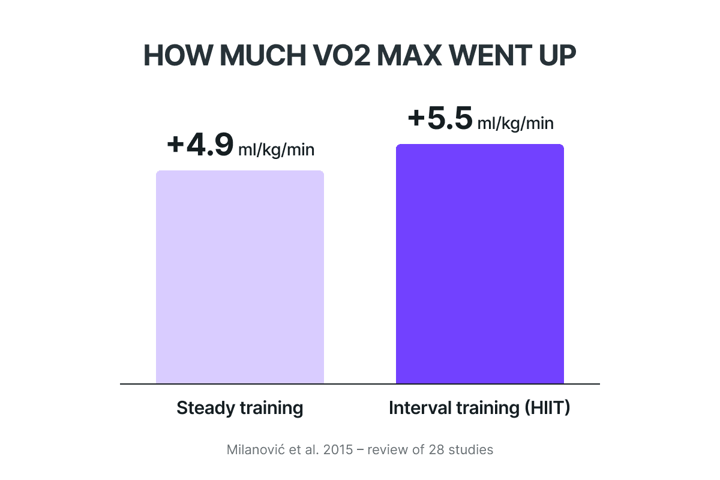
The short answer: both work. In a review of 28 controlled studies, steady endurance training raised VO2 max by about 4.9 ml/kg/min, and interval training by about 5.5.1 When researchers compared the two head-to-head, HIIT came out slightly ahead, by about 1.2 ml/kg/min.
For most people, the best way to increase VO2 max is to keep most of your cardio days easy and mix in one or two hard interval sessions a week. Let’s get into why.
What is VO2 max?
VO2 max is the maximum amount of oxygen your body can take in and use during all-out exercise. It's measured in milliliters of oxygen per kilogram of body weight per minute (ml/kg/min). Because it’s per kilogram, losing body fat also nudges your number up. In a lab, it’s often measured directly on a treadmill or bike. If you have a smartwatch, it can estimate your VO2 max from your heart rate and pace.
Two things decide your VO2 max:
- Your heart: how much blood it can pump with each beat.
- Your muscles: how well they pull oxygen out of that blood and use it for energy.
Working out improves both. Your heart gets stronger and pumps more blood per beat, and your muscles build more of the machinery your aerobic energy system relies on.
But why should you even care about this number? Large studies have found that people with higher cardio fitness tend to live longer. A meta-analysis of more than 100,000 people linked every extra MET of fitness (3.5 ml/kg/min of VO2 max) with about a 13% lower risk of dying early,2 and a study of over 120,000 adults who took a treadmill test found the fittest group had the lowest risk of all.3
These are observational studies, so they show a link, not proof that raising your VO2 max will add years to your life. Still, it's a pretty good reason to pay attention to it.
What is a good VO2 max for your age?
A good VO2 max depends on your age and sex. VO2 max naturally drops as you get older, and women tend to score lower than men because of differences in body composition and heart size.
The table below shows how VO2 max compares across age groups, based on data from the FRIEND registry.4 "Average" is the middle score. "Top 25%" means you scored higher than three out of four people your age.
| Age | Men: average | Men: top 25% | Women: average | Women: top 25% |
|---|---|---|---|---|
| 20–29 | 48.0 | 55.2+ | 37.6 | 44.7+ |
| 30–39 | 42.4 | 49.2+ | 30.2 | 36.1+ |
| 40–49 | 37.8 | 45.0+ | 26.7 | 32.4+ |
| 50–59 | 32.6 | 39.7+ | 23.4 | 27.6+ |
| 60–69 | 28.2 | 34.5+ | 20.0 | 23.8+ |
| 70–79 | 24.4 | 30.4+ | 18.3 | 20.8+ |
All values in ml/kg/min.
Your VO2 max number can vary depending on your smartwatch. Garmin, for example, uses ratings from the Cooper Institute, which are based on estimates and sit higher for most age groups. Either way, the trend matters more than any single number – if yours is going up, it’s a sign your training is working.
Is Zone 2 the best way to get fit?
Not on its own. Zone 2 builds a solid base, but the evidence doesn’t show it’s the best intensity, especially if your training time is limited.
The argument for Zone 2 training is simple: because it's low intensity, you can do more of it without putting too much strain on your body. This helps build your aerobic base and supports the development of mitochondria – the tiny power plants in your muscles that convert fuel into energy.
And there's some truth in that. Elite endurance athletes spend most of their training time at easy intensities, and they have some of the highest VO2 max scores ever recorded.
But in 2025, a group of exercise scientists took a closer look at where the Zone 2 advice actually comes from. Their conclusion? It rests mostly on observational data from elite athletes who train for many hours a week.
The evidence doesn't show that Zone 2 is the best intensity for building mitochondria, and for people with limited time to train, harder efforts appear to matter more, not less.5
So why do elite athletes still do so much easy work? A 2025 paper by a Finnish exercise researcher suggests a few possible reasons:6
- Recovery: easy days let athletes recover between hard sessions.
- Extra volume: easy training adds fitness without piling on more stress.
- Habit: some of it may simply be part of their routine – and could be replaced.
It's worth knowing that this is an expert's explanation, not something a study has tested.
On the flip side, HIIT promises the same results in a fraction of the time. So what does the science actually say?
What did 28 trials find?
The study: Milanović, Sporiš and Weston, Sports Medicine, 2015 – a meta-analysis of 28 controlled trials.
Who: 723 healthy adults aged 18–45 (average age 25, average starting VO2 max about 41 ml/kg/min).
What they did: Interval training (including sprint intervals) or steady endurance training for at least two weeks, compared with people who didn’t train.
What they found: Steady training raised VO2 max by about 4.9 ml/kg/min and interval training by about 5.5. In head-to-head comparisons, interval training beat steady training by about 1.2 ml/kg/min – a “possibly small” advantage.
Evidence strength: Strong for healthy adults under 45. Unknown for older adults and people with health conditions.
Does HIIT or Zone 2 raise VO2 max more?
Both raise your VO2 max, but HIIT has a small edge: about 1.2 ml/kg/min more than steady cardio like Zone 2.
To put these numbers into perspective, an increase of 5 ml/kg/min represents a VO2 max improvement of more than 10% for someone starting at a VO2 max of 40. That's a real boost in cardiovascular fitness, regardless of which training method you choose. It’s also roughly 1.4 METs, the unit behind the longer-life link above.
So, is HIIT better? Not by much. The whole online fight comes down to that 1.2 ml/kg/min – real, but not worth picking a team over. And it depends on how you train: HIIT’s edge grew with longer intervals and longer programs, and in people who started out less fit.
Other research supports these findings:
- Longer intervals work best. A 2019 review of 53 trials found that HIIT clearly beat steady training only when the hard intervals lasted 2 minutes or more and added up to at least 15 minutes per session. Shorter, low-volume HIIT sessions are still better than nothing.7
- HIIT only has a slight advantage. A 2023 meta-analysis of 29 trials in young and middle-aged adults found the same pattern: HIIT slightly ahead for cardio fitness, with a small effect.8
- Short on time? HIIT still delivers. In a small 2016 study, inactive men who did just 1 minute of all-out effort in a 10-minute workout three times a week improved their fitness as much as men who cycled steadily for 45 minutes. Only 25 men took part, so treat it as encouraging rather than settled.9
What the study doesn’t tell you
No single study can answer everything, and this one has clear limits:
- It didn’t test Zone 2 exactly. “Steady endurance training” covers a range of moderate efforts, not just the narrow Zone 2 band.
- Only healthy adults under 45 took part. The study excluded older adults and people with health conditions.
- It measured fitness, not health. VO2 max went up, but the study says nothing about lifespan or disease.
- The programs were short. They ran for weeks to months, so they can’t tell you what you’ll stick with for years.
- Averages hide big differences. Some people respond a lot to training, others barely, whichever method they use.
Zone 2 vs HIIT at a glance
When it comes to VO2 max training, Zone 2 and HIIT aren't rivals. They do different jobs, and the best training plans use both.
| Zone 2 cardio | HIIT | |
|---|---|---|
| Effort | Easy and conversational (about 60–70% of max heart rate) | Hard bursts (about 85–95% of max heart rate) with rest |
| Typical session | 30–60 minutes | 10–40 minutes, including Warmup |
| VO2 max gain, steady vs interval (Milanović 2015) | About +4.9 ml/kg/min | About +5.5 ml/kg/min |
| Time needed | More | Less |
| Recovery needed | Little – you can do it most days | More – one or two sessions a week is plenty |
| Best for | Building a base, active recovery, beginners | Busy weeks, pushing past a plateau |
How to increase your VO2 max: mix Zone 2 and HIIT
You don't have to choose one or the other. Our advice? Do most of your cardio at an easy pace and make one or two sessions a week your hard HIIT sessions.
You may have heard of this approach as 80/20 training, where roughly 80% of your endurance training is done at a low intensity and 20% at a higher intensity. Elite endurance athletes have used this method for years, and research supports its effectiveness.10,11
It also lines up with global guidelines. The World Health Organization recommends 150–300 minutes of moderate activity a week, 75–150 minutes of vigorous activity, or a mix of both.12 In other words, hard minutes count roughly double.
And if you don’t have a heart rate monitor? Use the talk test:
- Zone 2: you can speak in full sentences.
- Hard intervals: you can only get out a few words.
So what should those one or two hard sessions look like? The research above favors intervals of 2 minutes or more, and the best-studied one is the Norwegian 4x4.
What is the Norwegian 4x4 workout?
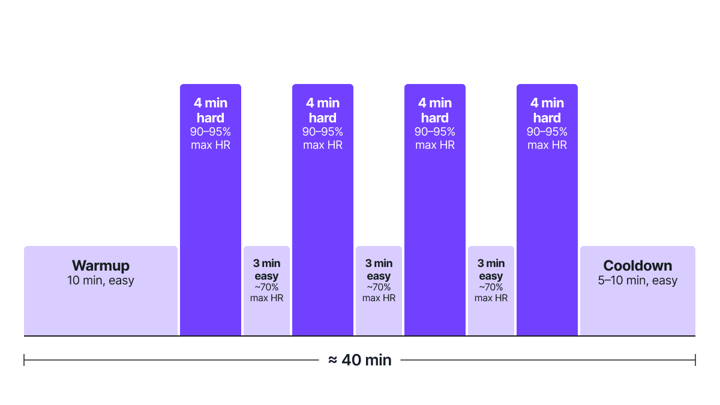
The Norwegian 4x4 is a HIIT workout developed by researchers at the Norwegian University of Science and Technology: 4 minutes of hard effort at 90–95% of your max heart rate, followed by 3 minutes of easy jogging, repeated 4 times.
In a 2007 study, researchers compared four different running plans in 40 moderately trained men over 8 weeks. All groups trained three times a week for the same total amount of work.
The results? The two steadier plans – running at 70% of max heart rate and running at lactate threshold – improved VO2 max significantly less than the interval plans. The Norwegian 4x4 group improved theirs by 7.2%, the biggest gain of the four.13
How to do the Norwegian 4x4 interval workout
If you want to give this interval session a try, here’s how:
- Warmup: 10 minutes at an easy pace.
- Work: 4 minutes hard, at about 90–95% of your max heart rate. You should only be able to get out a few words.
- Recover: 3 minutes at an easy pace, around 70% of your max heart rate. Keep moving.
- Repeat: 4 rounds in total.
- Cooldown: 5–10 minutes easy.
It works out to be about 40 minutes from start to finish. You can run it, ride it, row it, or for an added challenge, take it to a hill. No track or bike? Try a bodyweight version: 4 minutes of nonstop Burpees, Jumping Jacks, and High Knees at a hard effort, followed by 3 minutes of walking.
Don't skip the Warmup or the Cooldown – your heart and legs will thank you. For more on why intervals work, check out the benefits of interval running.
What does a VO2 max training week look like?
Here’s an example:
| Day | Session | Zone |
|---|---|---|
| Monday | Freeletics workout (intervals) | HIIT |
| Tuesday | 30–45-minute brisk walk or easy run | Zone 2 |
| Wednesday | Rest or mobility | – |
| Thursday | Norwegian 4x4 run or ride | HIIT |
| Friday | 30–45-minute easy ride or jog | Zone 2 |
| Saturday | 45–60-minute long walk, hike, or easy run | Zone 2 |
| Sunday | Rest | – |
Freeletics workouts are built around intervals, so your Coach already handles the hard part of the week. Add easy walks, runs, or rides around those sessions, and you've got the 80/20 mix covered.
Don’t skimp on strength training, either. Keep one or two strength sessions in your week. Strength training supports your cardio – it doesn't replace it. There's more on that balance in cardio vs strength training.
Starting from scratch? Begin with two or three easy 20–30-minute sessions a week, then add one short interval workout once those feel comfortable.
Already training regularly? Swap one steady session for the Norwegian 4x4 and give it 6–8 weeks before you judge the result.
Our take
Choosing between Zone 2 and HIIT matters far less than the internet makes it seem. Most people don’t lack the right intensity – they lack a plan they can stick to week after week.
Here’s what that means for you:
- Both methods work: Zone 2 and HIIT can both improve your VO2 max.
- HIIT has a slight edge: about 1.2 ml/kg/min extra on average, in less time.
- Longer intervals win: hard efforts of 2 minutes or more, like the Norwegian 4x4, work best for VO2 max.
- Find a balance: aim to keep roughly 80% of your endurance training easy and 20% at a higher intensity, adjusting the mix to your fitness level and recovery needs.
Zone 2 vs HIIT is a fake fight – the biggest VO2 max gains come from doing both. Start with your easy days, add one hard session, and let your Coach take care of the intervals.
Try Freeletics nowFAQ
Does Zone 2 increase VO2 max?
Yes. Steady, moderate cardio – the category Zone 2 belongs to – raised VO2 max by about 4.9 ml/kg/min in a review of 28 studies.
How long does it take to improve VO2 max?
In studies of 6–13-week interval programs, VO2 max went up clearly on average.14 The fastest gains come in the first few months. After that, progress slows, so keep adding a little time or intensity every few weeks.
Can you improve VO2 max as you get older?
Yes, you can improve your VO2 max as you get older. A meta-analysis of 41 trials in adults aged 60 and over found that endurance training improved VO2 max by about 16% compared with people who didn’t train. Longer programs, of more than 20 weeks, worked best.15
Is HIIT or Zone 2 better for fat loss?
HIIT burns more calories per minute, while Zone 2 lets you keep going for longer. Over a whole week, the difference is small. What really moves fat loss is your total activity and your diet, so pick the mix you'll actually keep doing.
Can beginners do HIIT?
Yes, beginners can do HIIT – just scale it to your current fitness level. Start with shorter, less intense intervals and longer rests, and keep most of your week easy. If you have a heart condition or haven't exercised in a long time, talk to your doctor before you start.
Sources
[1] Milanović, Z., Sporiš, G., & Weston, M. (2015). Effectiveness of high-intensity interval training (HIT) and continuous endurance training for VO2max improvements: A systematic review and meta-analysis of controlled trials. Sports Medicine, 45(10), 1469–1481.
[2] Kodama, S., Saito, K., Tanaka, S., et al. (2009). Cardiorespiratory fitness as a quantitative predictor of all-cause mortality and cardiovascular events in healthy men and women: A meta-analysis. JAMA, 301(19), 2024–2035.
[3] Mandsager, K., Harb, S., Cremer, P., et al. (2018). Association of cardiorespiratory fitness with long-term mortality among adults undergoing exercise treadmill testing. JAMA Network Open, 1(6), e183605.
[4] Kaminsky, L. A., Arena, R., & Myers, J. (2015). Reference standards for cardiorespiratory fitness measured with cardiopulmonary exercise testing: Data from the Fitness Registry and the Importance of Exercise National Database. Mayo Clinic Proceedings, 90(11), 1515–1523.
[5] Storoschuk, K. L., Moran-MacDonald, A., Gibala, M. J., & Gurd, B. J. (2025). Much ado about Zone 2: A narrative review assessing the efficacy of Zone 2 training for improving mitochondrial capacity and cardiorespiratory fitness in the general population. Sports Medicine, 55(7), 1611–1624.
[6] Matomäki, P. (2025). Why low-intensity endurance training for athletes? European Journal of Applied Physiology, 125(9), 2401–2407.
[7] Wen, D., Utesch, T., Wu, J., et al. (2019). Effects of different protocols of high intensity interval training for VO2max improvements in adults: A meta-analysis of randomised controlled trials. Journal of Science and Medicine in Sport, 22(8), 941–947.
[8] Guo, Z., Li, M., Cai, J., et al. (2023). Effect of high-intensity interval training vs. moderate-intensity continuous training on fat loss and cardiorespiratory fitness in the young and middle-aged: A systematic review and meta-analysis. International Journal of Environmental Research and Public Health, 20(6), 4741.
[9] Gillen, J. B., Martin, B. J., MacInnis, M. J., et al. (2016). Twelve weeks of sprint interval training improves indices of cardiometabolic health similar to traditional endurance training despite a five-fold lower exercise volume and time commitment. PLoS One, 11(4), e0154075.
[10] Seiler, S. (2010). What is best practice for training intensity and duration distribution in endurance athletes? International Journal of Sports Physiology and Performance, 5(3), 276–291.
[11] Stöggl, T., & Sperlich, B. (2014). Polarized training has greater impact on key endurance variables than threshold, high intensity, or high volume training. Frontiers in Physiology, 5, 33.
[12] Bull, F. C., Al-Ansari, S. S., Biddle, S., et al. (2020). World Health Organization 2020 guidelines on physical activity and sedentary behaviour. British Journal of Sports Medicine, 54(24), 1451–1462.
[13] Helgerud, J., Høydal, K., Wang, E., et al. (2007). Aerobic high-intensity intervals improve VO2max more than moderate training. Medicine & Science in Sports & Exercise, 39(4), 665–671.
[14] Bacon, A. P., Carter, R. E., Ogle, E. A., & Joyner, M. J. (2013). VO2max trainability and high intensity interval training in humans: A meta-analysis. PLoS One, 8(9), e73182.
[15] Huang, G., Gibson, C. A., Tran, Z. V., & Osness, W. H. (2005). Controlled endurance exercise training and VO2max changes in older adults: A meta-analysis. Preventive Cardiology, 8(4), 217–225.


